The Problem
Shalom Village is an assisted living community exploring whether virtual reality could improve residents' quality of life. There was no app to redesign, no wireframes to sketch, and no existing product to fix. The organization needed something different first: evidence. Residents range widely in mobility, cognitive engagement, and prior comfort with technology, and that range shaped the evaluation framework and workshop design from the start.
Before any resident put on a headset, three questions had to be answered honestly. Does VR actually work for people in assisted living, or is that just marketing? Which of the many headsets and platforms on the market are actually built for this population? And is it worth the money?
I met separately with David Neumann, my academic advisor, and Tracy Humphreys, Shalom Village's wellness coordinator and the project's main stakeholder, to understand what each of them needed by the end of this project. Tracy's priority was resident-centric: whether this would genuinely improve quality of life for people she works with every day, not whether the technology was impressive on its own. She also brought her own knowledge of individual residents into every decision along the way, from recruitment to how to read reactions in the room. Those conversations shaped the three questions above.
Research
A systematic review of the published research on VR in aging care: 43 studies, spanning 2019 to 2026, synthesized to separate what the evidence actually supports from what vendors claim.
What the evidence supports
- Consistent reductions in stress, anxiety, and negative affect across multiple study designs
- Improved social connectedness and reduced isolation, particularly through shared/group VR experiences
- Staff consistently report visible increases in resident engagement, energy, and mood
What the evidence warns about
- Cybersickness, dizziness, and eye strain are real and exclude some participants. One study reported 18.6% exclusion
- Heavy headsets and complex controllers create real barriers for frail residents and those with dexterity limitations
- Staff cite Wi-Fi instability, technical difficulty, and lack of time/confidence as adoption barriers, not just cost
Technology landscape. Six VR options were compared: three general-purpose consumer headsets, one prosumer mixed-reality headset, and two subscription platforms purpose-built for senior living.
| Option | Type | Specialized for Older Adults? | Facilitator Required? | Approx. Price |
|---|---|---|---|---|
| Meta Quest 3 | Hardware | No | Recommended | $829.99 CAD |
| Meta Quest 3S | Hardware | No | Recommended | $479.99 CAD |
| HTC Vive Focus Vision | Hardware | No | Yes (enterprise-configured) | ~$1,000 USD |
| Samsung Galaxy XR | Hardware | No | Recommended | $1,799 USD |
| Rendever | Platform + Service | Yes | Required (staff-controlled tablet) | ~$8,000 CAD Yr 1 |
| Mynd Immersive (MyndVR) | Platform + Service | Yes | Recommended | ~$5,500 CAD Yr 1 |
Only Rendever and Mynd Immersive are purpose-built for senior care. They bundle hardware, curated content, staff training, and support. The consumer headsets are cheaper but require sourcing content, training, and facilitation separately. Meta Quest 3 was selected as this project's working headset. No senior-specific design, but the best balance of adjustable IPD, passthrough support, and price for a pilot that still needed to evaluate content independently.
Key Insight
The Evaluation Framework
Rather than judging VR experiences by feel, I built a 20-point heuristic evaluation template. Section A is Nielsen Norman Group's 10 core usability heuristics for VR. Section B is 10 Older Adult Accessibility heuristics I wrote myself, each one derived directly from a specific finding in the literature review and cited back to its source. Every experience under consideration was evaluated against all 20 before it was allowed near a resident.
| Heuristic | SoulRetreat | YouTube VR |
|---|---|---|
| Section A · NNG Core Usability | ||
| H1 · Visibility of System Status | Pass | Pass |
| H2 · Match Between System & Real World | Pass | Pass |
| H3 · User Control & Freedom | Pass | Pass |
| H4 · Consistency & Standards | Pass | Pass |
| H5 · Error Prevention | N/A | Pass |
| H6 · Recognition Rather Than Recall | Pass | Pass |
| H7 · Flexibility & Efficiency of Use | Pass | Pass |
| H8 · Aesthetic & Minimalist Design | Pass | Partial |
| H9 · Recognize, Diagnose & Recover From Errors | N/A | Pass |
| H10 · Help & Documentation | Pass | Partial |
| Section B · Older Adult Accessibility | ||
| OA-1 · Visual Clarity & Sensory Adjustability | Pass | Fail |
| OA-2 · Auditory Accessibility & Noise Load | Pass | Pass |
| OA-3 · Cybersickness & Vestibular Safety | Pass | Partial |
| OA-4 · Physical Comfort & Seated Accessibility | Pass | Pass |
| OA-5 · Simplified Interaction & Motor Accessibility | Pass | Partial |
| OA-6 · Cognitive Accessibility & Reduced Overload | Pass | Partial |
| OA-7 · Spatial Orientation & Wayfinding | Pass | Pass |
| OA-8 · Multi-Modal Feedback & Sensory Redundancy | Pass | Pass |
| OA-9 · Emotional Safety, Cultural Relevance & Reminiscence | Pass | Pass |
| OA-10 · Facilitator Accessibility & Staff Operability | Partial | Pass |
The gap between 94% and 70% isn't a judgment on content quality. Both were selected for the workshops. It's the difference between an experience designed to require nothing from the user and one that needs a facilitator managing the parts residents shouldn't have to see. In practice, YouTube VR was often the easier one to run: a facilitator could load and position the video in advance, so a resident's headset went on already set up and all they had to do was press play. SoulRetreat scored higher and had simpler interactions once running, but getting to "running" still meant a resident, or a facilitator standing over them, working through its own launch sequence first. The heuristic score measures the experience once it starts, and for this population, what happens before that mattered more.
Key Decisions
SoulRetreat to Gibraltar Peak Meditation
Workshop 3 was originally planned as SoulRetreat, the meditation app that scored highest in the heuristic evaluation (94% pass rate, fully passive once launched). After watching residents struggle to operate the controllers in earlier live sessions, we swapped it for Gibraltar Peak Meditation, a YouTube VR video the facilitator could load in advance and hand over ready to go, removing controller interaction from the resident's side entirely. A strong heuristic score describes an interface on paper. It doesn't guarantee a specific resident's hands will get along with a specific controller in the room. The swap cost us nothing: Workshop 3 posted the highest average emotional rating of the series (3.33/5).
Quest 3 Over Quest 3S
Quest 3 beat the cheaper Quest 3S despite the higher price. Its passthrough camera reads as working to residents, where the 3S's grainier passthrough read as broken technology, a difference that matters more for this population's trust in the hardware than the price gap does.
Running the Workshops
Three experiences were selected against six criteria drawn from the literature review: low motion-sickness risk, simplified controls, adjustable visual settings, cognitive accessibility, reminiscence potential, and the ability to exit or pause without penalty. Delivered across three consecutive weekly 90-minute sessions (July 13, 20, and 27), each followed the same four-part structure: orientation, the VR activity itself, a semi-structured debrief, and a short anonymous survey for residents and staff.
Three measurement tools ran alongside the sessions: a Self-Reported Emotional Scale completed before and after each session, an Observed Emotion Rating Scale completed by staff during the activity, and a Senior Technology Acceptance Model questionnaire tracking comfort with the technology over the series.
I facilitated all three sessions myself: running the protocol, taking observational notes, troubleshooting headsets in the moment, and talking directly with residents throughout. Tracy Humphreys and Kristhel supported headset setup, resident orientation, and additional observation.
· Facilitator script, Step 2 safety briefing
Recruitment ran through word of mouth and a printed poster displayed at Shalom Village, with sign-up coordinated through the recreation team.
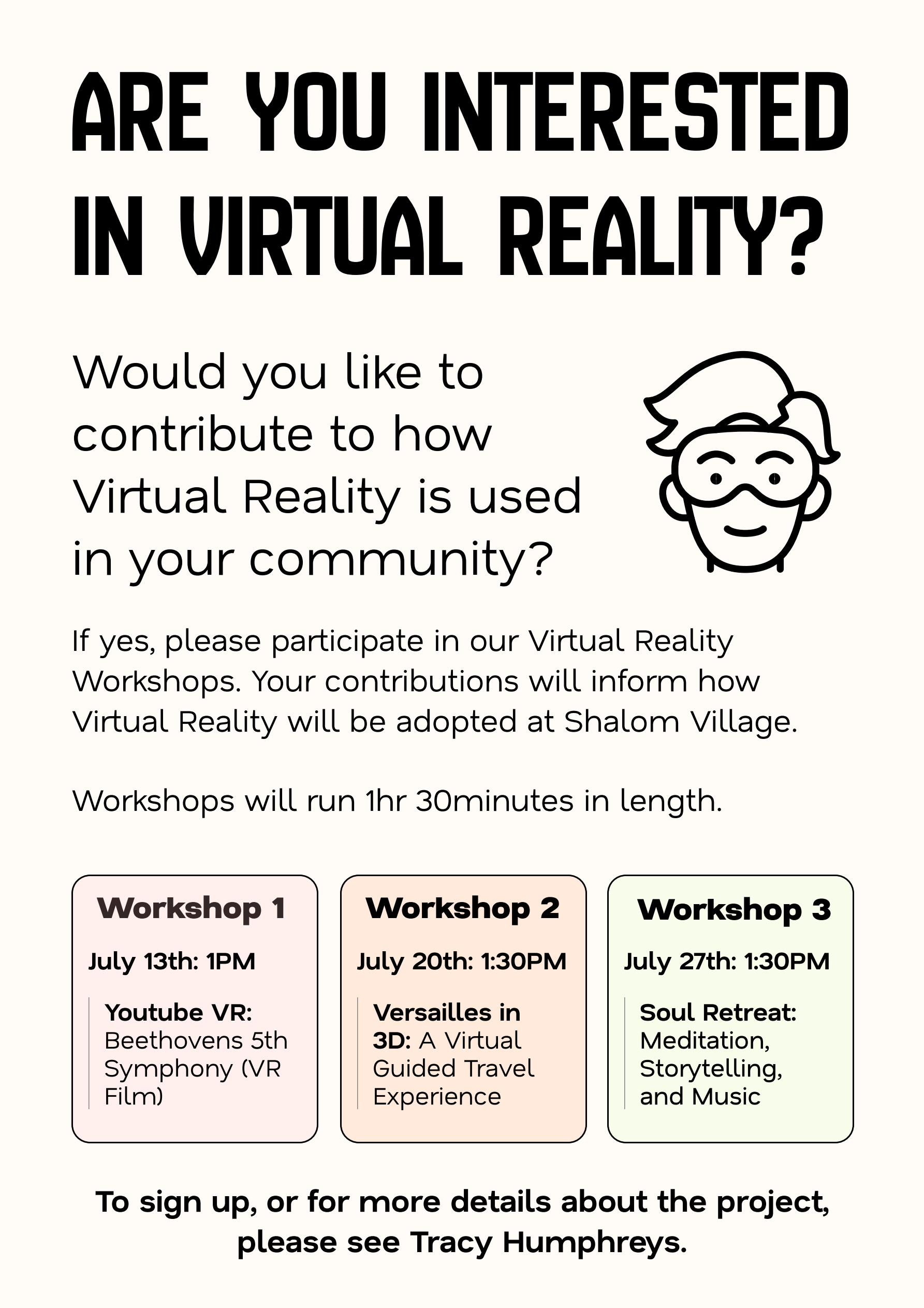
Every resident who signed up was screened against basic health and safety criteria and completed informed consent before their first session, coordinated with Shalom Village's wellness team given the range of cognitive ability across the resident population.
Attendance & Retention
All three workshops ran as scheduled. Eight residents attended across the series, tracked through the Self-Reported Emotional Scale and the Observed Emotion Rating Scale.
| Workshop | Experience | Attendance | Avg. Self-Reported Emotion |
|---|---|---|---|
| 1 · Jul 13 | Beethoven's 5th Symphony | 5 residents | 3.0 / 5 |
| 2 · Jul 20 | Versailles in 3D | 4 residents | 3.25 / 5 |
| 3 · Jul 27 | Gibraltar Peak Meditation | 6 residents | 3.33 / 5 |
Retention wasn't uniform, and the pattern says more than the average would. Four participant types emerged across the three sessions.
The Loyal Anchor
Attended all 3 workshops · steady 3/5 every time
Undramatic, consistent attendance despite observer notes ranging from "quiet, unsure" to "no visible enjoyment." This resident kept coming and said outright: "I would enjoy the VR experience on a regular basis at Shalom." A stable presence a program can be built around.
The Enthusiast Returnee
Joined at Workshop 2 · 5/5 both sessions attended
The highest and most consistent emotional ratings in the cohort. Briefly dizzy at the Gibraltar cliffside, took the headset off, and stayed for the rest of the session anyway: "I felt so calm, my eyes shut."
The Agency-Seekers
Three residents · moderate, control-dependent engagement
Engagement tracked closely with how much choice they had. One resident only came alive once allowed to pick their own experience, smiling and laughing for the first time only after that. Control wasn't a nice-to-have for this group, it was the difference between disengagement and delight.
Did Not Return
Two residents · attended Workshop 2 only
Both attended once and didn't re-register. Neither reported discomfort or safety concerns. One said plainly, "I don't understand how this could help me," a confidence and framing gap, not a harm signal, and the clearest argument for a longer onboarding runway.
Six residents completed a post-experience survey covering Emotional Experience, Physical Comfort, and Intent to Return.
Headset comfort was the one soft spot in an otherwise strong picture: it scored 2.83 out of 5, well below every other item on the survey. Every other physical-comfort item (pain, dizziness, eye strain, neck strain) scored at or near the ceiling.
Cost. Four acquisition pathways were modeled at pilot and full-program scale over a three-year horizon.
| Pathway | One-time (Year 1) | Annual Ongoing | 3-Year Total |
|---|---|---|---|
| Pilot · 2 Meta Quest 3 headsets | $2,161.92 | ~$220 | ~$2,800 CAD |
| Full program · 6 Meta Quest 3 headsets | $4,696 | ~$470 | ~$7,000 CAD |
| Platform: MyndVR | ~$5,500 | ~$5,100 | ~$15,700 CAD |
| Platform: Rendever | ~$8,000 | ~$7,000 | ~$22,000 CAD |
The hardware-only pilot costs a fraction of even the cheapest platform subscription, but the platforms bundle training and support that a hardware-only path leaves entirely to Tracy Humphreys. The cost model doesn't make that decision, it makes the tradeoff visible, which led to the recommendation below: start hardware-only and small.
The Answer: Yes, With Conditions
Bottom-line recommendation: proceed with purchasing 2 Meta Quest 3 headsets. All three questions from the start of this project now have real answers. VR is viable and desirable for Shalom Village's residents, provided it's facilitated and the content is chosen thoughtfully rather than assigned. The cost is modest relative to the impact: a 2-headset pilot runs about $2,161.92 CAD one-time plus roughly $220 CAD a year after that.
The plan is staged, not a single purchase. Start with 2 headsets and the four residents most likely to build early momentum. Expand to 10–15 residents and 6 headsets by month six if the evaluation metrics hold, and fold VR into standard programming, alongside art, music, and physical therapy, by month twelve.
The single point of failure
Shalom Village's Wellness department is Tracy Humphreys and no one else. She'll facilitate the pilot directly, which fits the data: residents rated themselves less confident using VR alone (2.0/4) than with someone demonstrating (2.57/4). But a program that depends entirely on one person's calendar isn't a program, it's a risk. A backup facilitator from outside Wellness needs to be identified and trained before this scales past the pilot.
Immediate next steps
- Budget approval for ~$2,161.92 CAD in pilot hardware
- Identify and begin training a backup facilitator
- Procure 2 Meta Quest 3 headsets and assemble a curated content library
The full methodology, data set, and final recommendations report were delivered to Shalom Village leadership at the end of the placement.
Design Materials
There was no product to brand here, but residents and staff still needed materials that felt warm and legible rather than clinical. I carried a consistent identity across the recruitment poster and workshop materials: high contrast for aging eyes, soft per-session color-coding, and a friendly illustrated tone that reads as inviting rather than institutional.
#FFFCF8
#000000
#FFF0ED
#FFEADB
#F8FCEA
A bold, condensed display face for headlines, paired with a rounded, friendly sans-serif for body copy. The pairing favors legibility and warmth over polish: large type, high contrast, nothing italicized or thin enough to strain aging eyes.
ComponentsEach workshop session gets its own color-coded card, a simple pattern repeated from the poster into the facilitator materials so residents and staff could recognize "Session 2" at a glance across documents.
- High contrast, large type sized for older-adult readability
- Soft, distinct per-session color-coding rather than a single accent color
- A friendly illustrated figure to soften the unfamiliarity of VR hardware
- Plain, direct language over promotional copy
Takeaways
-
Evidence has to come before advocacy
It would have been easy to walk in enthusiastic about VR and design a workshop to prove it. Building the literature review and heuristic framework first meant the final recommendation is defensible, not just optimistic.
-
Retention isn't one number, it's four different stories
A 75% return rate on its own says almost nothing about how to run this program. The Loyal Anchor, the Enthusiast, the Agency-Seekers, and the residents who didn't come back each needed something different from the experience. The average was the least useful number in the dataset.
What This Shows
This project demonstrates:
- The ability to operate without a design brief: building research and evaluation methodology from scratch
- Rigorous, literature-grounded thinking applied to a real vendor and technology decision
- Facilitation of human-subjects research with a vulnerable population, with safety and dignity built into every step
- Comfort presenting an honest cost-benefit picture instead of a predetermined recommendation
- Synthesizing self-report, staff-observed, and qualitative data into one coherent, honest narrative, including the outlier that complicates it
- Applied UX skills, heuristic evaluation and accessibility thinking, outside of a traditional product design context